

Contrast Border Sarees: The 2026 Celebrity Detail, Decoded

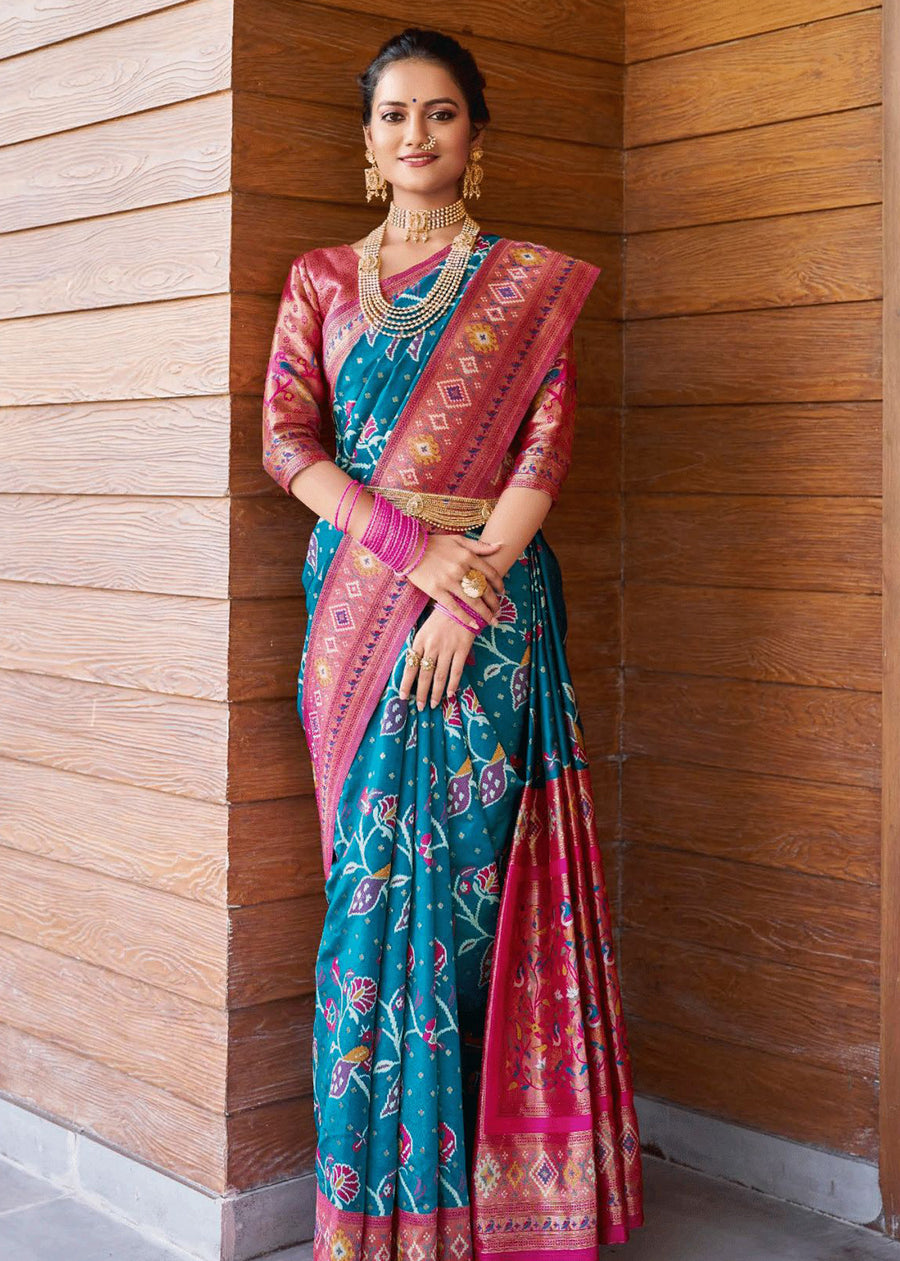
A contrast border saree is one where the border is woven in a different colour from the body — and on a genuine handloom, that border is a separate weave physically interlocked into the body, not a printed or dyed edge. It is the single detail behind almost every celebrity saree moment of 2026: purple with a pink border, blue with a rose border, yellow with a violet edge. The reason it photographs so well has nothing to do with the celebrity and everything to do with how the eye reads a hard colour boundary.
What a contrast border actually is (and the join you can feel)
On a true Kanjivaram, the contrast border is not woven as part of the body. The body and the border are woven on separate warps and locked together by a technique called korvai — in some weaving clusters it is also called pitni. Traditionally, a korvai Kanjivaram needs more than one weaver at the loom, because the interlocking has to happen thread by thread as the body advances.
Here is the part nobody tells you: you can feel it. Run your thumb along the inside edge of the border on a korvai saree and you will find a faint ridge, about the thickness of a hair, running the full 5.5 metres. Tug gently across that line and the two sections resist separating — they are interlocked, not stitched. On a single-shuttle saree, where the "contrast" is just a colour change in the same weft, there is no ridge at all. The surface is perfectly flat.
Neither one is fake. A single-shuttle contrast border is an honest, well-made saree at a lower price. But if someone is charging you korvai money, the ridge is your receipt.

The 2026 celebrity formula: analogous, not complementary
Look at the contrast borders that went viral this year and a pattern appears. Purple body with a pink border. Deep blue with rose. Wine with magenta. These are analogous pairings — colours that sit next to each other on the colour wheel — not the textbook complementary pairs (purple with yellow, red with green) that dominated wedding sarees a decade ago.
This is where I will take a position: analogous contrast borders photograph better than complementary ones, and it is a camera problem, not a taste problem. Highly saturated complementary edges — a hard yellow against a hard purple — make phone cameras clip at the boundary, and you get a muddy fringe where the two colours meet. An analogous border gives the sensor a gentler gradient, so the zari stays crisp and the border reads as a deliberate design line instead of a stripe.
Practically: if your photographs matter more than the room, choose a border within two or three steps of the body colour. If you want to be seen from the back of a hall, go complementary and let the camera lose.

Border width: the number nobody quotes you
Most contrast borders on the market fall between 3 and 5 inches. Under 3 inches reads as a fine line and disappears in photographs. Between 3 and 5 inches is the working range for almost everyone. Above 5 inches — and grand wedding Kanjivarams routinely run 7 to 9 inches — you are wearing a horizontal band that sits at your calf and again across your shoulder.
My honest read after handling a lot of these: if you are under 5'3", a border wider than about 5 inches will cut your vertical line at exactly the wrong height, and no amount of heel height fixes it. Wide borders belong on taller frames or on nine-yard drapes where the pleating absorbs them. This is the most common reason a saree that looked spectacular on a hanger looks squat in a photograph.
Three checks before you buy a contrast border saree
- The ridge test. Thumb along the border join. A ridge means korvai; a flat surface means single-shuttle. Ask the seller which one it is rather than guessing from the price.
- The pallu join. On a contrast-border saree the border, body and pallu all meet at one point, and that junction takes the full stress of your pleats. Check it is dense and even — a loose or gappy pallu join is where the saree will fail first, usually after three or four wears.
- Reverse-side colour. Turn the border over. On a woven contrast border the colour is present on both faces, because it is thread. If the reverse is pale or ghosted, the "border" is surface treatment, not weave.

Shop the Edit
These are all in stock and sit in the range where a contrast border is genuinely woven rather than printed. Prices are our regular list prices — seasonal offers at checkout often bring these lower.
- Allports Blue and Pink Woven Kanchipuram Saree — ₹5,594. The closest thing we stock to the viral analogous formula: a deep blue body against a pink contrast border.
- Russet Purple Handloom Kanjivaram Saree — ₹6,003. An earthy purple with contrast borders and zari motifs; the muted base keeps it wearable beyond weddings.
- Yellow Oleander and Purple Woven Kanjivaram Saree — ₹9,299. The complementary version, if you want to be seen across a hall.
- Pastel Violet Handloom Kanjivaram Saree — ₹6,003. Powdery violet with contrast borders — the daytime, mehendi-and-haldi end of this trend.
- Pine Green Woven Banarasi Silk Saree — ₹5,699. Proof the idea is not only a South Indian one; Banaras does contrast edges beautifully.
Browse the full range of Kanjivaram sarees, or see how Banaras handles the same idea in our Banarasi saree collection. If you want the long version on korvai, zari counts and what each price tier actually buys, our complete Kanjivaram silk saree guide covers it end to end, and the silk saree buying guide walks through spotting fakes.
Frequently asked questions
What is a korvai border on a Kanjivaram saree?
Korvai is the technique where the border is woven on a separate warp and interlocked thread by thread into the body, rather than woven continuously with it. It traditionally requires more than one weaver at the loom. You can identify it by a faint ridge along the inside edge of the border that runs the whole length of the saree.
How wide should a contrast border be?
Three to five inches suits most people and most occasions. Narrower than three inches vanishes in photographs; wider than five inches creates a horizontal band that shortens the frame, which is why very wide borders work best on taller wearers or on nine-yard Nauvari-style drapes where pleating absorbs the width.
Is a contrast border saree suitable for daily or office wear?
Yes, if you keep the border narrow and the palette analogous. A pastel body with a three-inch tonal border in soft silk or a lightweight Banarasi reads polished rather than festive. Save the wide, high-zari complementary borders for weddings and receptions, where the scale suits the setting.

Shop contrast borders by weave and shade
The three looks in this piece each have their own edit, and the korvai question comes down to how the saree was woven in the first place:
- For the korvai and interlocked-border question, start with authentic handloom sarees — the loom-woven pieces where a separate border warp is actually possible.
- The viral analogous formula in its most-worn shade: purple and violet sarees, from russet to powdery pastel.
- For the blue-body-with-a-rose-border look, browse our deep blue sarees.
- If you want the narrow, tonal border for office and daytime wear, our lightweight soft silk sarees drape closest to what that last answer describes.
The contrast border is the cheapest luxury in a saree: it costs the weaver an extra warp and it changes everything about how the drape reads. Start with the Kanjivaram collection and check the ridge — once you know what you are feeling for, you will never buy a border blind again.


Leave a comment
This site is protected by hCaptcha and the hCaptcha Privacy Policy and Terms of Service apply.