

Saree Delivery to Singapore (2026): the S$400 GST Rule, Zero Customs Duty & What You Actually Pay
A silk saree shipped from India to Singapore attracts no customs duty at all — Singapore levies duty on only four categories of goods, and textiles are not one of them. What you do pay is 9% GST, and the only real question is who collects it: for items valued at S$400 or less sent by air or post, a GST-registered overseas seller charges it at checkout; above S$400, the courier collects it before release. Since almost every saree on the MySilkLove global store sits between roughly S$33 and S$140, virtually every order falls in the first bracket — which is why a Singapore delivery is usually the most predictable landed cost of any of our export markets.
Why Singapore is the cleanest market to receive a saree in
Singapore operates as a free port. More than 99% of goods enter duty-free, and customs or excise duty applies to just four categories: intoxicating liquors, tobacco products, motor vehicles and petroleum products. Silk, cotton and blended textiles are outside that list entirely, so there is no tariff line to argue about, no HS-code surprise and no duty invoice waiting at the door.
That is a meaningful difference from the other big NRI markets. Canadian buyers face MFN tariff rates on apparel; American buyers have had no de-minimis cushion since June 2026. In Singapore, the tax picture is a single number — 9% GST — and it is entirely predictable before you order.
The S$400 rule, in plain terms
Since 1 January 2023, Singapore has taxed imported low-value goods. The mechanics matter because they decide whether you are billed at checkout or at delivery:
- Low-value goods are goods with a sales value of S$400 or less imported by air or post. Shipping and insurance are excluded when working out that value — it is the price of the goods only.
- The threshold is assessed per item, not per parcel. Two S$120 sarees in one box are two low-value items, not a single S$240 consignment, and the same logic holds even if the box total climbs past S$400.
- For low-value goods, GST is charged by the overseas seller at the point of sale if that seller is registered under Singapore's Overseas Vendor Registration regime. If it is not, the tax is settled on import instead.
- For a single item above S$400, GST is collected at import — in practice, the courier bills you (usually with a small handling fee) before releasing the parcel.
Check your checkout screen: if a GST line appears there, nothing further is owed on delivery. If it does not, budget the 9% for the courier.
What a saree actually costs to land in Singapore
Prices on the global store display in live Singapore dollars, converted at the rate of the day. In early September 2026 the Singapore dollar was trading around ₹75, so the bands below are indicative rather than fixed — the exact figure is calculated in SGD at checkout.
| Order value (approx.) | Customs duty | GST | Shipping | What arrives at your door |
|---|---|---|---|---|
| Under about S$80 (under ₹6,000) | None | 9%, low-value goods regime | Charged at checkout | Nothing extra if GST appeared at checkout |
| About S$80 – S$140 (₹6,000 – ₹10,500) — where most silk sarees sit | None | 9%, low-value goods regime | Free above the ₹6,000 threshold | Nothing extra if GST appeared at checkout |
| Single item above S$400 | None | 9%, collected on import | Free | Courier bills GST plus a handling fee before release |
For context on the item side: everyday soft-silk and printed silk sarees generally run about S$33–S$60, mid-weight woven Paithani and Kanjivaram-style pieces about S$58–S$125, and the heaviest zari-woven sarees currently in stock top out near S$140. If a Singapore boutique is quoting S$300–S$600 for a comparable mid-range weave, you are paying a reseller margin, not a weaver's price.

The shipping and returns terms worth reading first
Two details catch out first-time overseas buyers, and both are easier to handle before you order than after:
- Shipping is free above ₹6,000 (roughly S$80), or above ₹7,000 if you add blouse stitching. Below that, a shipping charge is calculated at checkout. Delivery to Singapore addresses — Little India, Serangoon, the East Coast, Jurong, HDB and condo alike — typically runs about 5–9 working days with tracking.
- International orders carry a short return window and no exchanges, and adding blouse stitching makes a saree non-returnable, because the blouse piece has been cut. If you are unsure about a colour or a fall-and-pico choice, order the saree unstitched and have it finished locally.
How to check the weave is what the listing claims
You cannot feel the fabric through a screen, so read for specifics rather than adjectives:
- Korvai on a Kanjivaram. In a true Kanchipuram weave, the contrast border and pallu are woven separately and interlocked with the body by hand — the korvai join. It is the reason the border sits differently from a printed "Kanjivaram look", where border and body are one continuous piece of cloth.
- Silk Mark on pure silk only. The Silk Mark Organisation of India issues a numbered hologram certifying natural silk. A pure-silk saree can carry it; a silk blend or art-silk cannot, and an honest listing says which one you are buying rather than calling everything "pure silk".
- Zari, named honestly. Traditional zari is silver thread gilded with gold; most contemporary sarees use tested zari, which is entirely legitimate and far more affordable. What matters is that the price matches the claim.
- Weight and cluster. Ask for the weight — a light drape is roughly 400–550g, a heavy occasion weave closer to 800–900g — and where it was woven. Kanjivaram comes from Kanchipuram in Tamil Nadu; Paithani from Paithan in Maharashtra, where the pallu's motifs are built with an interlocked tapestry weft rather than printed on.

Where to start browsing
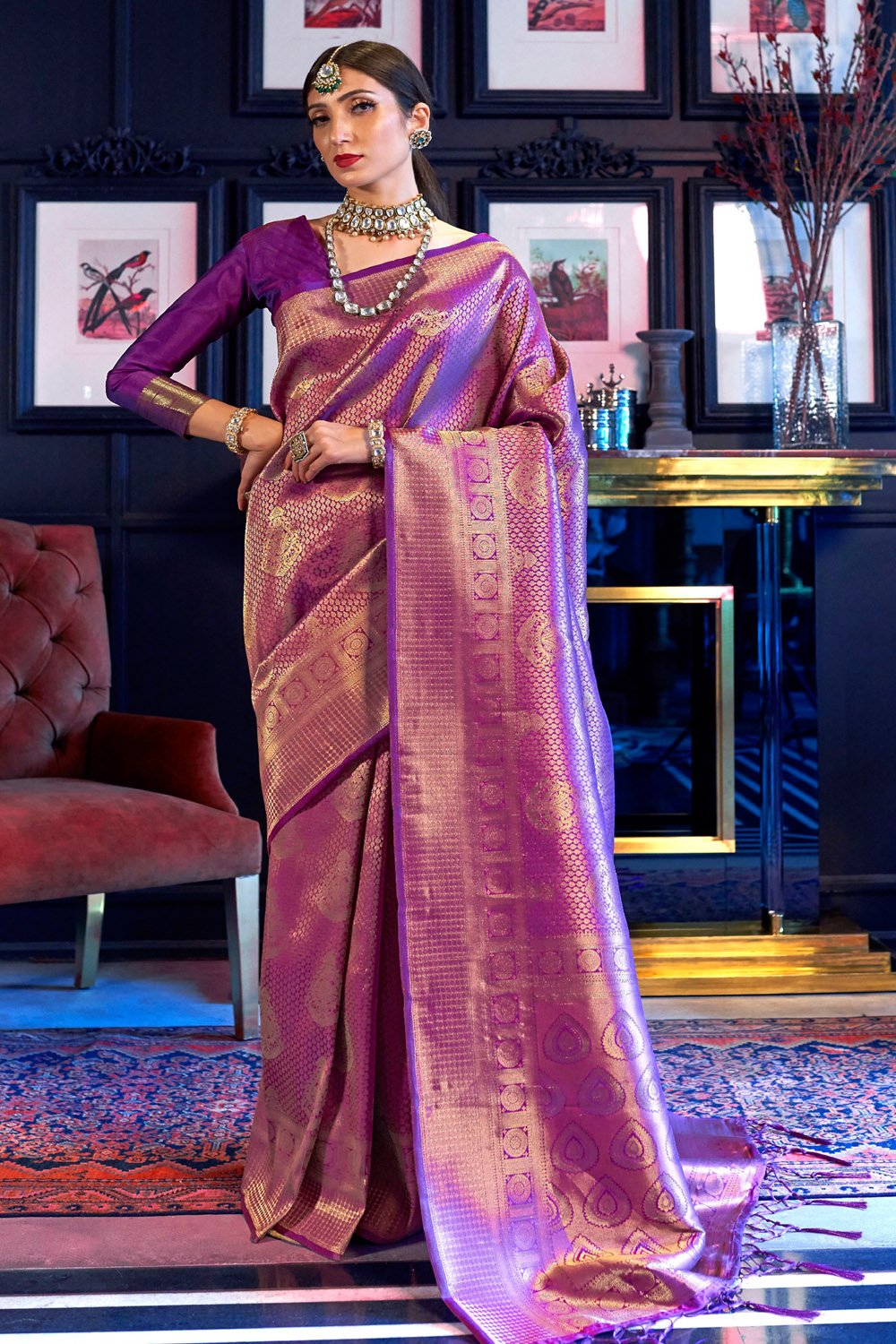
For a Singapore wedding, temple function or Deepavali, most buyers begin with the Kanjivaram collection for weight and gold-toned zari, or the Paithani collection for a motif-led occasion piece. The Banarasi range sits between the two for formal evenings, and the Wedding Edit pulls the bridal-grade pieces together. If you would rather start from a Singapore-specific view with SGD pricing and delivery details, the Silk Sarees in Singapore page is the place to begin.
Frequently asked questions
Do I pay import duty on a saree sent to Singapore?
No. Singapore charges customs or excise duty on only four categories — liquors, tobacco, motor vehicles and petroleum. Textiles including silk sarees enter duty-free. The only tax that applies is 9% GST.
Is the S$400 threshold per parcel or per saree?
Per item. Each saree is assessed on its own sales value, excluding shipping and insurance, so a box holding several sarees under S$400 each is still treated as low-value goods.
Will the courier ask me for money on delivery?
Only if GST was not collected at the point of sale, or if a single item exceeded S$400. If a GST line appeared at checkout, the parcel is settled and nothing further is owed.
Is buying online from India cheaper than a Singapore boutique?
Usually, yes. Even with 9% GST and shipping added, ordering direct from the source skips the reseller margin that local retail adds — often two to three times the Indian price for the same weave.

Shop the weave, not the label
If you would rather start from the fabric than the occasion, three edits cover most of what travels well to Singapore. The soft silk saree collection holds the lighter, everyday-weight drapes that suit the humidity and pack flat. The handloom saree collection is where the hand-woven pieces sit — the korvai joins, the interlocked tapestry pallus and the heavier weights described above. And the printed saree edit is the honest place to look if you want motif-led colour at a print price rather than a woven one.
Tax rules and thresholds described here reflect Singapore Customs and IRAS guidance current in September 2026; verify with the official sources before a large order. Prices are indicative and convert to live SGD at checkout on the global MySilkLove store.


Leave a comment
This site is protected by hCaptcha and the hCaptcha Privacy Policy and Terms of Service apply.