
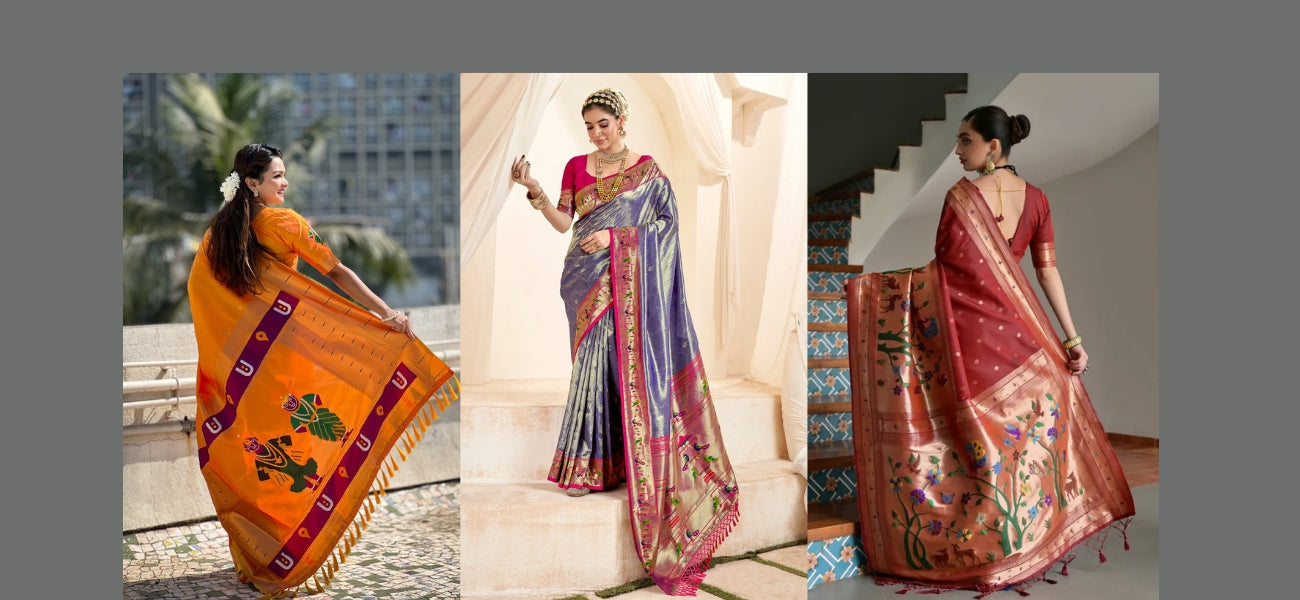
How to Identify a Real Paithani Saree: The Maharashtra Weaver's Test (2026)
The fastest way to tell a real Paithani saree from a power-loom copy: flip the pallu over. On an authentic handwoven Paithani, the motif — a peacock, lotus, or parrot — looks identical on both sides, with no loose floating threads at the back. This "reversible" finish comes from the interlocked tapestry technique used by weavers in Yeola and Paithan, Maharashtra, and it is almost impossible to fake on a machine. If the back of the border is messy or the motif only appears on one face, it is not a true Paithani.
Below is the complete buyer's test — weave, zari, price tiers, and occasion — so you know exactly what you are paying for before you buy a Paithani saree online.

1. The reversible pallu and border test
A real Paithani is woven using the tapestry (kadiyal) technique, where the border and pallu are woven separately from the body and interlocked thread by thread. Because each motif is built up by hand with individual zari and silk threads, both sides of the pallu mirror each other perfectly. Power-loom imitations print or embroider the motif onto one face only, leaving a tangle of threads behind. Always check the reverse first.
2. Look for real zari, not metallic film
Traditional Paithani zari is made from fine silk thread wrapped in gold- or silver-toned metal. Genuine zari has a soft, warm glow and does not crack when you gently fold it. Cheap copies use plastic-coated metallic film that looks brassy, feels stiff, and flakes at the fold. Rub a border thread between your fingers — real zari stays smooth; film catches and squeaks.
3. Know the classic motifs
Authentic Paithani designs come from a fixed traditional vocabulary: the Mor (peacock), Bangadi Mor (peacock in a bangle), the lotus (Akruti), the parrot (Tota-Maina), and the Asawali flowering vine. The most prized is the Bangadi Mor pallu, which can take a weaver several weeks to complete. If a saree claims to be Paithani but carries random floral digital prints, treat it with suspicion.
4. What each price tier actually gets you
Paithani pricing reflects how much real silk and pure zari went into it, and how much was hand-woven versus semi-mechanised:
- ₹2,000–₹5,000: Semi-silk or soft-silk Paithani-style sarees with imitation zari — great for festive wear and everyday celebration, but not pure handloom.
- ₹5,000–₹15,000: Pure-silk Paithani with semi-pure zari and a single classic motif pallu — the sweet spot for wedding-guest and reception wear.
- ₹15,000 and above: Fully handwoven Yeola Paithani with pure zari and an intricate Bangadi Mor pallu — heirloom pieces that take weeks to months on the loom.
5. Choose by occasion
For Vat Purnima, Gudi Padwa, and Maharashtrian weddings, the traditional choice is a deep-toned pure-silk Paithani — royal blue, bottle green, magenta, or the classic peacock-neck combination of green-and-blue. For receptions and festive parties, a lighter soft-silk Paithani drapes more easily and photographs beautifully. First-time buyers often start with a semi-silk Paithani before investing in a pure handloom piece.

Frequently asked questions
Are Paithani and Yeola sarees the same?
Yeola is the town in Nashik district, Maharashtra, where most Paithani sarees are woven today. "Yeola Paithani" simply means a Paithani woven in that hub. The name Paithani itself comes from Paithan, the ancient town where the weave originated.
Why is a real Paithani so expensive?
Because it is woven entirely by hand on a traditional loom, motif by motif, using pure mulberry silk and real zari. A detailed Bangadi Mor pallu alone can take weeks. You are paying for hundreds of hours of skilled handwork, not a printed pattern.
How do I care for a Paithani saree?
Always dry-clean a pure-silk Paithani, store it wrapped in a cotton or muslin cloth (never plastic), and refold it along different lines every few months so the zari does not crack at the creases.

Ready to buy? Explore our handpicked Paithani saree collection and our wider range of Maharashtrian sarees. If you are weighing Paithani against another silk weave, read our guide to choosing between the great Indian silk weaves.
Shop by the test you just ran
The Paithani and Maharashtrian shelves are linked in the paragraph above, so this section takes the four other threads of the guide somewhere useful. The whole reversible-pallu test is really a handloom-versus-powerloom test — browse handloom sarees to start from pieces tagged for the loom rather than the machine. For the lighter, easier-draping tier section 5 recommends for receptions and festive parties, explore soft silk sarees. The Banana Yellow piece opening this guide is a tissue Paithani, and that shimmering zari-ground family has its own shelf — see the tissue saree edit. And for the reception and festive-party occasion named in the same section, browse reception sarees. All four are rule-built to list only pieces with stock recorded against them.

Leave a comment
This site is protected by hCaptcha and the hCaptcha Privacy Policy and Terms of Service apply.