

Chanderi vs Maheshwari: Two Madhya Pradesh Weaves, Decoded (2026)
Chanderi and Maheshwari are both handloom traditions from Madhya Pradesh, and shoppers mix them up constantly — but they are not interchangeable. Chanderi is defined by transparency: the raw silk yarn goes onto the loom without being degummed, and that un-stripped filament is what gives the fabric its glassy sheen and see-through body. Maheshwari is defined by its border: a reversible bugdi weave that reads identically on the front and the back, so the saree can be draped either way. If you remember one thing: a Chanderi you hold up to the light, a Maheshwari you flip over.

The 30-second test that tells them apart
You do not need a loom to identify these two. You need daylight and your hands.
- Hold it up to a window. A Chanderi will let light through — you should be able to see the outline of your fingers behind the body of the saree. A Maheshwari will not. That single check settles most arguments in a shop.
- Turn the border over. On a genuine Maheshwari bugdi border, the reverse looks the same as the front — same motif, same crispness, no loose float threads carrying colour across the back. If you flip a border and see a messy underside, it is a plain border, not a bugdi.
- Count the stripes on the pallu. The traditional Maheshwari pallu carries five stripes — three coloured, two white. It is one of the oldest signatures in the weave and a fast tell on a photo listing.

Why a Chanderi is see-through (and why that matters in August)
Most silk yarn is degummed before weaving — boiled to strip off sericin, the natural gum coating the filament. Chanderi weavers skip that step. The yarn reaches the loom with its gum intact, and the result is a fabric that is simultaneously sheer and glossy in a way no degummed silk can imitate. That is not a shortcut; it is the entire point of the weave.
Chanderi fabric received its GI tag in 2005, making it one of the earliest Indian handlooms on the register, and it comes out of Chanderi town in Ashoknagar district. Around 3,600 handlooms and roughly 11,000 weavers still work the cluster. The classic construction runs fine cotton against un-degummed mulberry silk, and you will find three families in the market: pure silk Chanderi, Chanderi cotton, and the silk-cotton blend most people actually mean when they say "Chanderi".
The practical consequence is weight. Chanderi sits somewhere between 35 and 150 GSM. A bridal Kanjivaram runs 700–900g on the hanger; a Chanderi is a fraction of that, and you feel the difference after four hours at a daytime function in an un-airconditioned hall.
One thing nobody warns you about: the transparency is a feature, not a defect — but it makes your petticoat part of the outfit. Match the petticoat to the saree's ground colour, not to the border. A black Chanderi over a beige petticoat reads as a mistake from across a room, and it is the single most common way a good Chanderi gets worn badly.

Maheshwari: the border you can wear both ways
Maheshwar sits on the banks of the Narmada, and the weave owes its modern form to Rani Ahilyabai Holkar, who patronised and organised the craft in the 18th century — the story goes that she commissioned the first of these sarees as gifts for royal guests, and set the five-stripe pallu that survives today.
The technical marvel is the bugdi. The zari or silk border is woven so precisely that front and back are indistinguishable. That is not a marketing line — it changes how the saree wears. One saree gives you two border presentations depending on which face you drape outward, and a border that frays slightly is far less visible than it would be on a conventional weave. The motifs are drawn from the town itself: the lattice and brick patterns of Maheshwar Fort, and wave forms taken from the Narmada.
Our honest verdict: which one to buy first
If you are buying one and only one, buy the Maheshwari. It is more forgiving. The reversible border means you cannot really drape it wrong, it holds a crisper pleat through a long day, and it does not ask anything of your petticoat. Chanderi rewards a confident wearer — it needs the right underlayer and a blouse you are content to have partly visible.
That said, we will argue the unpopular position too: Chanderi is badly underrated for office wear. A Chanderi-woven drape beats a heavy silk in a warm room every single time, it photographs well under fluorescent light, and it does not announce itself the way a zari-heavy weave does at 10am on a Tuesday. If your saree wardrobe is all festive silk and nothing wearable on a working day, that is the gap Chanderi fills.
What you'll actually pay in 2026
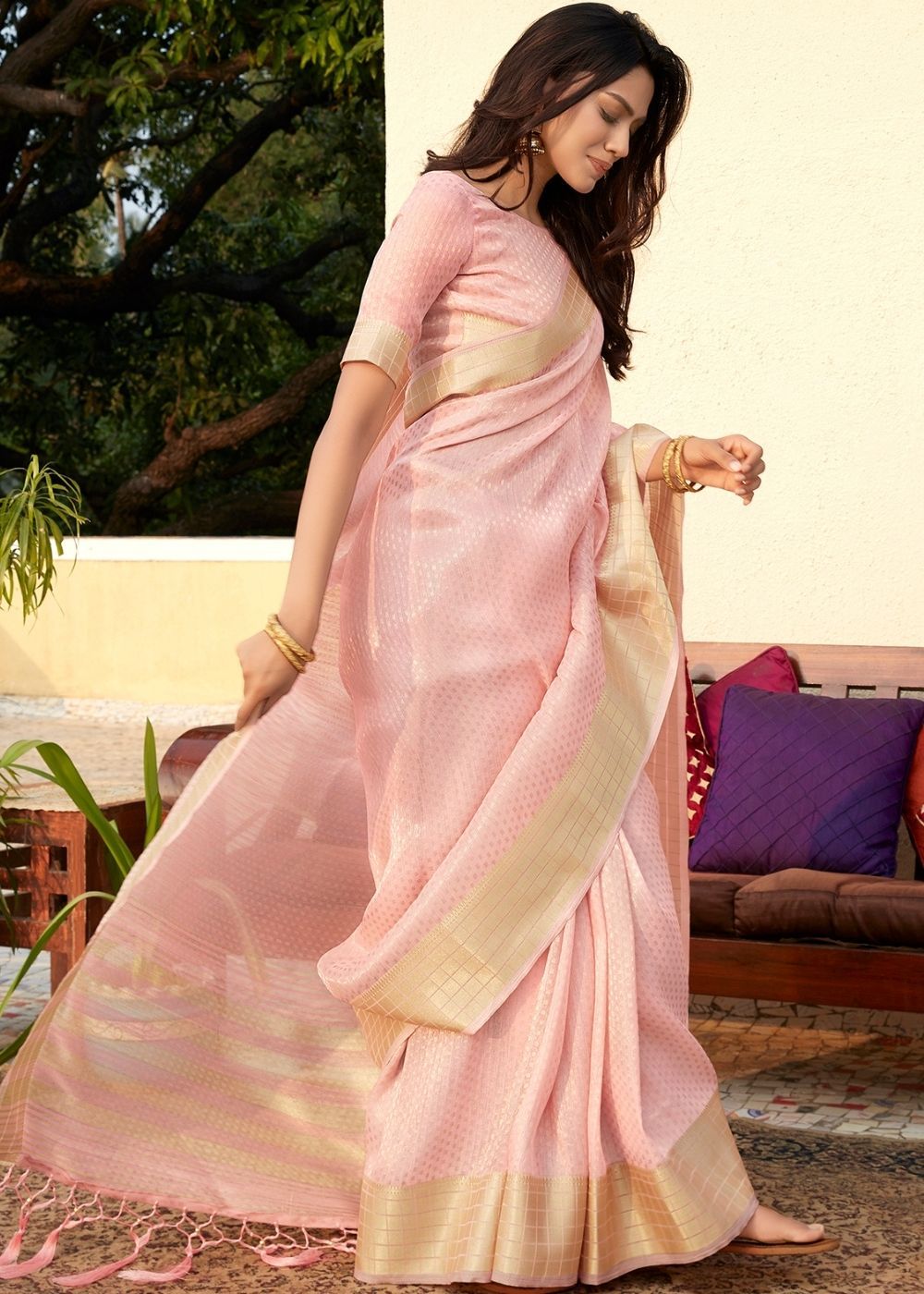
Across the market, handloom Chanderi in silk-cotton generally opens around ₹3,500–₹6,000 and climbs past ₹15,000 for pure silk with substantial zari. Maheshwari in cotton-silk commonly sits in the ₹2,500–₹8,000 band, with reversible-border pieces in real zari at the top of it.
On our own shelves, the Maheshwari woven silk sarees are listed at ₹4,050 and the Chanderi-woven linen drapes at ₹3,578. Seasonal offers at checkout often bring these lower.
An important piece of plain speaking: the Chanderi pieces we carry are linen-ground with Chanderi weave detailing — light, breathable and genuinely good for office and daytime wear, but not the silk-cotton handloom that comes off the Chanderi cluster looms. We would rather tell you that than let the word "Chanderi" in a product title do work it has not earned. If you want the full framework for separating handloom from powerloom before you spend, our complete silk saree buying guide walks through the tests one by one, and the saree occasions guide covers what to reach for at which event.
Shop the Edit
- Grandis Yellow Maheshwari Woven Silk Saree — a warm daytime yellow, the easiest entry point into the weave
- Tradewind Blue Maheshwari Woven Silk Saree — the safest Maheshwari for a wedding-guest slot
- Como Green Maheshwari Woven Silk Saree — green reads well in festive photographs without going loud
- Mauvelous Pink Chanderi Linen Saree — the office-day drape, soft enough for a full working day
- Bunker Black Chanderi Linen Saree — pair with a matched black petticoat, not a nude one
- Heathered Green Chanderi Linen Saree — the quiet one, and the one that gets worn most
Browse the wider linen sarees collection for more Chanderi-woven options, or the summer sarees edit if breathability is the deciding factor. For the heavier weaves, start at silk sarees.
Frequently asked questions
Is a Chanderi saree silk or cotton?
Both, usually. The classic Chanderi pairs un-degummed mulberry silk with very fine cotton, which is why it is sheer and glossy at the same time. You will also find pure silk Chanderi and pure cotton Chanderi in the market, so always check the fabric line on the listing rather than assuming.
Can you really wear a Maheshwari saree on both sides?
The border, yes. The bugdi technique weaves the border so it looks identical front and back, letting you drape either face outward for two different looks. The body and pallu are not fully reversible on every piece, so check the pallu before planning to flip the whole saree.
Which is better for summer, Chanderi or Maheshwari?
Chanderi, on weight alone — at roughly 35 to 150 GSM it is one of the lightest handlooms in India and moves air freely. Maheshwari is still comfortable and holds a crisper pleat, so pick it when you need the saree to look structured after eight hours rather than simply feel cool.
Shop these two weaves
Browse the full Chanderi saree collection — the linen-ground Chanderi drapes described above, alongside a few zari-woven Chanderi Banarasi pieces. For the office-wear case this guide argues for, the office wear sarees edit gathers the lighter, quieter drapes that work at 10am on a Tuesday. And if it is the handloom question that brought you here, the authentic handloom sarees collection is where the loom-woven pieces sit.
Two towns, two entirely different answers to the same question of what a saree should do. Start with whichever matches the life you actually dress for — browse the summer sarees collection and let weight, not weave-name prestige, make the call.


Leave a comment
This site is protected by hCaptcha and the hCaptcha Privacy Policy and Terms of Service apply.